Guillermo del Toro’s Pinocchio Movie Review (2022)
A visually stunning stop-motion reimagining of the classic tale, Guillermo del Toro’s Pinocchio offers a darker and more philosophical take on the story.
 The first time I heard about Guillermo del Toro was in 2006, when Pan’s Labyrinth was released. He has since become one of the biggest names in film, receiving accolades for movies ranging from The Shape Of Water to Frankenstein. I have always wondered what he dreams about at night because, during the day, the visions he creates are fascinating.
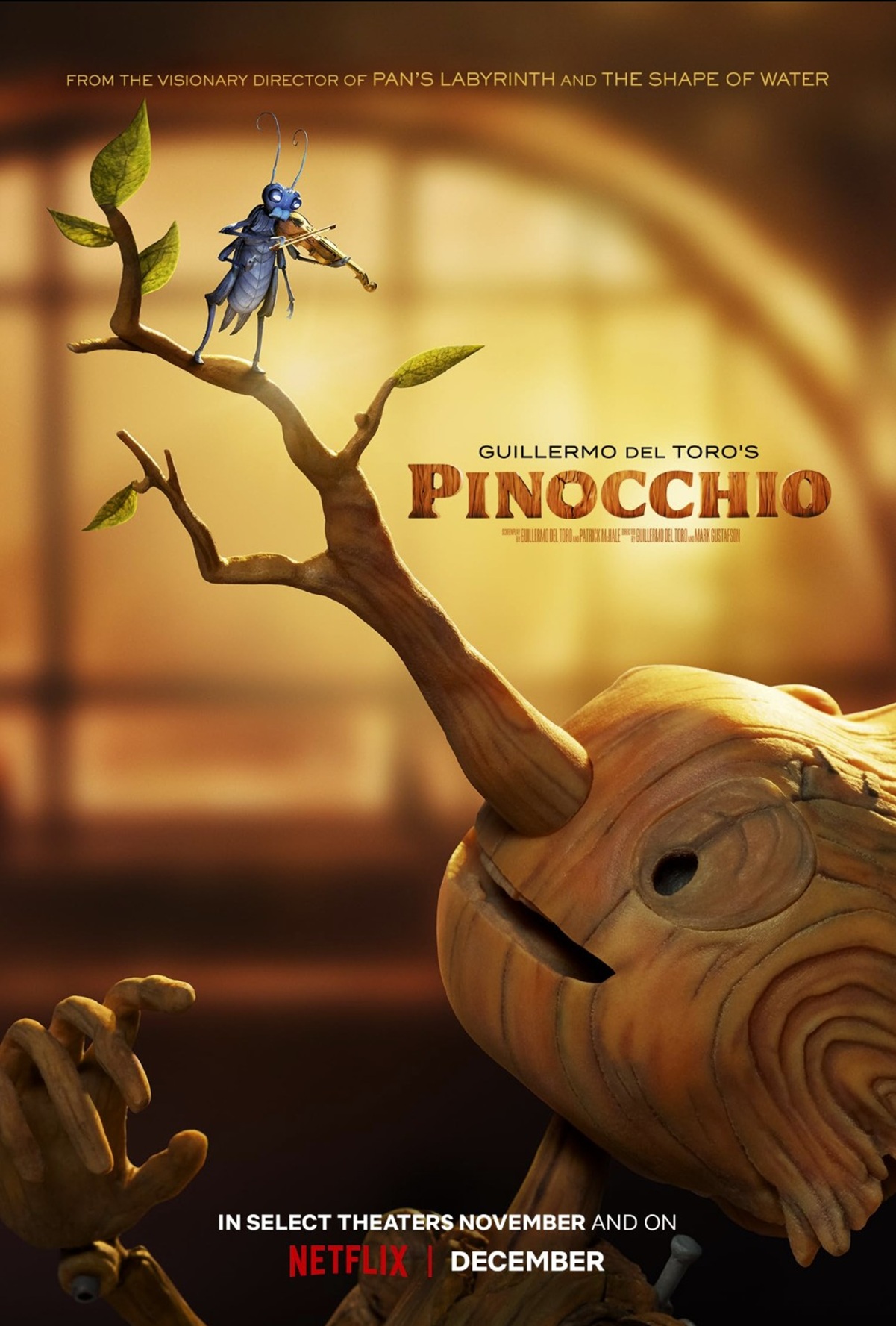
Guillermo del Toro’s Pinocchio takes place in Italy, where a woodcarver named Geppetto loses his son, Carlo, to a bombing during World War I. He plants a tree at Carlo’s grave and mourns him, while watching the pine tree grow. Years later, and without knowing that little Sebastian J. Cricket has moved into the tree, a drunk Geppetto cuts it down and fashions the wood into a puppet while wishing his son were still alive. Overnight, a Wood Sprite arrives, gives life to the puppet, and instructs the cricket to be his guide. From here, an innocent and honest wooden Pinocchio finds himself being used by various bad actors and discovers that if he dies, he is restricted to wait out an hourglass in the afterlife with Death before he can return to live again.
This is no Disney version of Pinocchio. It is much darker, much richer, and the storytelling is much more intricate. Based on the original book, The Adventures of Pinocchio by Carlo Collodi in 1983 (a nice nod to Carlo being Geppetto’s son in this film version), del Toro has chosen to get rid of “The Blue Fairy” and “Jiminy Cricket,” choosing to explore a more ethereal Wood Sprite (who is the sister of Death) and Sebastian J. Cricket, who has had his own travels and life thus far, and is more haughty than gentle.
The visuals in this film are truly staggering, with stop-motion animation as the base. Every character is lush and beautiful, with weathered clothing and fully expressing themselves through worried eyebrows, mouth twitches, and human-like body movements. I was especially struck by Geppetto’s gorgeous hair, eyebrows, and beard, which are so intricately designed that I wanted to touch them just to see how they felt. This goes for every other character as well, I just kept coming back to him.
The sets are designed just like you would for a movie with human actors. Details abound, with aged walls, stained glass, and stone buildings, and the puppets’ movements within the sets are flawless and natural.
This version of Pinocchio is very politically charged, with children expected to obey rather than form opinions, and with authoritarianism under Mussolini being the norm. At one point, Pinocchio enters combat alongside many other children who are expected to behave like soldiers and take orders without question, but Pinocchio is different. He is not built that way, and there are consequences for his choices, even if he spreads his example to others before they happen.
With some very entertaining musical moments, a unique look, and an undercurrent of love from everyone involved with the project, Guillermo del Toro’s Pinocchio is an excellent display of how the perfectly imperfect are, in fact, human. A great film for adults and children alike.
Runtime: 121 minutes
Motion Picture Rating: PG
Languages Spoken In The Film: English
Should You Watch It? Yes
Did I Cry? Nope
My Rating: 4/5 Stars
Available: Free on Netflix